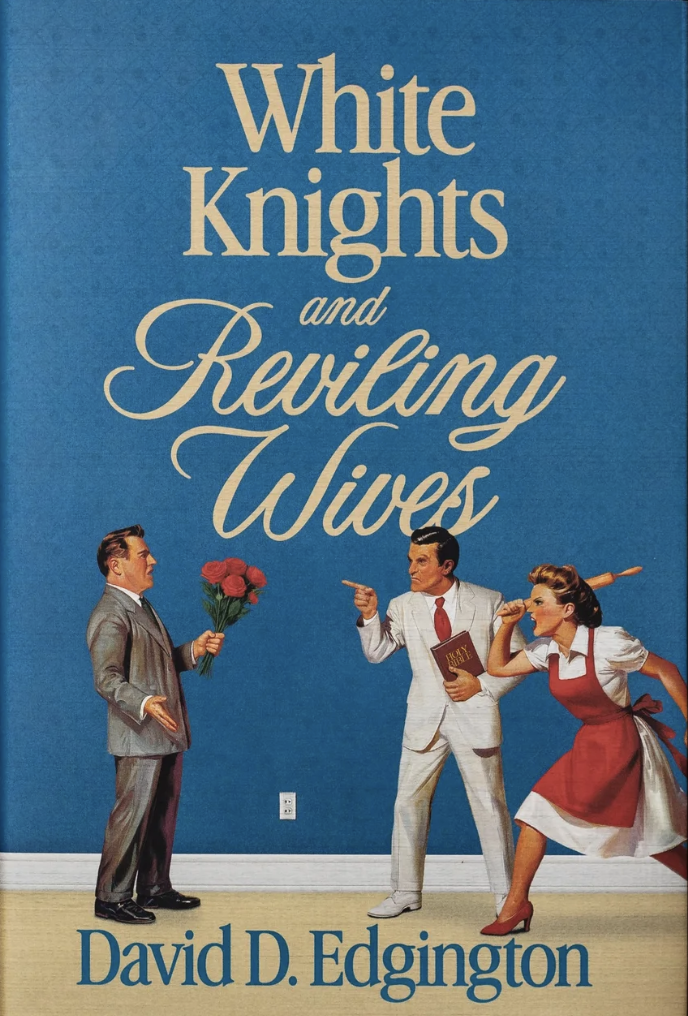
A Review of White Knights and Reviling Wives: How Feminism Destroys Families by David Edgington (New Christendom Press, 2025)
David Edgington’s new book, White Knights and Reviling Wives, is sure to make waves. However, those waves may come from the pew more than the pulpit. But they will eventually reach the pulpit. Pastors and Christian counselors will likely ignore this book for the time being. The reason is that the book will require them to repent. And repentance is hard, especially when it requires admitting you’ve been an accomplice to unjust divorce and the destruction of families.
White Knights and Reviling Wives is the follow-up to Edgington’s 2015 self-published book, The Abusive Wife. Edgington is an experienced pastor and counselor with a PhD, and if the Christian publishing world was functioning in a healthy way, then Edgington’s first book would have been readily accepted and widely distributed. Jay Adams endorsed it prior to his death in 2020, but he represented a saner generation. Thankfully, New Christendom Press has arisen and filled the void by taking on Edgington’s work.
Pastors and Counselors Siding with Reviling Wives
Feminism has indeed infiltrated the church, and it’s rearing its ugly head in how Christians handle cases of marital conflict. Even when a wife is sinning, pastors and counselors often side with her and against the husband. They are even blaming the husband for the wife’s sin. This may sound absurd, but it is indeed happening. And it is the result of years of pastors, elders, and counselors capitulating to feminism rather than affirming the teaching of Scripture.
Edgington’s book focuses on a type of woman that many Christians do not acknowledge exists—the “Reviling Wife.” His prior book, The Abusive Wife, explained how the “Reviling Wife” (RW) “is controlling, hostile, enraged, bitter, and unforgiving—and she refuses to submit to her husband” (1). Such a woman may even be physically violent, while her husband is usually kind and loving. This Reviling Wife is now a common actor in our post-feminist culture, including in the church.
The existence of such women is bad enough. But far, far worse is that the church is not helping the men who are dealing with such wives. Sadly, Edgington says that “churches—including both pastors and counselors (even ‘nouthetic’ ones)—have abandoned these men and do nothing to help them.” Worse, Edgington says, “I would estimate that 90 percent of pastors/counselors actually blame these suffering men for their abusive and reviling wives” (1). So what is happening today is that rather than church leaders calling women to submit to their husbands as the Bible commands, they cowardly sanction the wife’s rebellion and “expect the men to repent for the sins of their wives” (2). The husband often gets ambushed by the church, and then the wife is granted permission to divorce her husband “for clearly unbiblical reasons” (4).
Lest you think Edgington is exaggerating the problem, the man has counseled at least 500 cases involving a Reviling Wife (4). Although my own experience here is limited, I have seen such cases myself. This includes another church and its pastors completely fumbling a marital conflict, leading to the wife unjustly divorcing her husband and then fabricating allegations so as to keep the innocent man from seeing his children.
What could cause such widespread pastoral malpractice? Edgington says it is “willful blindness” and “pride.” Such pastors and counselors are often “willing to entertain gossip” by meeting with the wife alone to hear her complain about her husband—rather than meeting with both husband and wife so as to prevent such gossip (see the section on chapter 5 below). The proper practice, of course, is to hold “both the woman and the man accountable for their sins” (7). We used to call such practices common sense. But the cloud of feminism overshadows such reasonable thinking.
Complementarianism, Patriarchy, and Submission
White Knights and Reviling Wives is broken into four parts. Part I (Foundations) covers biblical patriarchy and submission. Some may think this section is unnecessary and makes the book longer than it needs to be, but it sets the groundwork for the rest of the book. For if one does not properly understand the Bible’s teaching on the husband’s rule and the wife’s submission, then he will not understand the problem of feminism and the Reviling Wife.
In chapter 1 (“Patriarchy Is Biblical”), Edgington is critical of “complementarianism” (which he calls “feminism lite”) for “jettison[ing] the authority that God has given to men.” Complementarians often speak only of a tiebreaking vote in marriage, and in practice, the husband is often pressured to submit to his wife (21). Complementarianism “basically takes the position that women don’t sin—or, when they do sin, that it’s either no big deal or their husbands’ fault” (22). What is concerning is that this approach “has snuck in through the backdoor of good conservative churches” (23). These churches have “white knights”—men who have “unknowingly embraced feminism and who will defend the [Reviling Wife] to the bitter end” (24).[1] I myself have criticized complementarianism, and although the label is broad, it does seem that the softening of the Bible’s teaching on male headship has aided the church’s mishandling of the Reviling Wife.
Edgington provides an excellent second chapter on wifely submission (“‘Submission’ Is not a Dirty Word”). Noting that God commands wives to submit to their husbands “in everything” (Ephesians 5:24), Edgington explains that the unsubmissive wife rebels against God and puts herself above His Word (32, 58). He gives examples of what submission is not: “I’ll follow you, husband, as long as I agree with what you say,” or, “I’ll follow you, husband, once you become worthy of being followed,” or “I’ll inform you, husband, of how I want you to lead me” (35). Sadly, pastors often support such folly from wives and thus displace the husband as head. Unsurprisingly, “most husbands won’t go to their pastors for marital counseling,” since there “is an extraordinarily high probability that the pastor will automatically side with the wife” (42). Edgington also provides a section on why women initiate divorce more than men (42–44), and he gives advice to unmarried men looking for a woman who will make a submissive wife (47–55).
This leads into chapter 3 (“The Demonic War with the RW”), in which Edgington explains the similarities between so many cases of Reviling Wives. The root problem, he notes, is that such women are following the devil rather than God. Edgington even testifies to counseling women who did demonic things, such as a wife attempting to jump out of a moving car the husband was driving, a wife intentionally getting a pet that her husband was allergic to, and a wife laughing as she recounted physically assaulting her husband (72).
Critical Gender Theory
Part II (Failures) explains the failures of many pastors and counselors, as well as what lies behind much of the problem—Critical Gender Theory. In Chapter 4 (“Pastors Who Don’t Pastor”), Edgington explains that pastors often focus on preaching but entirely neglect counseling their members. Instead, “Many pastors actually direct their flocks to secular therapists and psychologists who never even open their Bibles or pray during counseling” (84). I fully agree with Edgington that such men are not really acting as “pastors” by failing to shepherd the flock outside the pulpit, and I endorse his advice to “Find a church that will counsel against the sins of women, not just preach against them” (90). One thing I would add to the list of pastoral malpractice, which Edgington did not mention, is the lack of pastoral visitation—which is proactive counseling. Earlier Reformed and Puritan ministers regularly visited their church members as a way of checking in on their spiritual wellbeing. This practice aids preaching and prevents many crisis counseling situations. Yet pastoral visitation is largely neglected today. Most pastors neither do proactive counseling (visitation) nor reactive counseling when problems arise.
However, I differ with Edgington’s statement that pastors who do not do counseling often “preach the Word very well” (83). I think this needs to be qualified (and I think Edgington would likely agree with my elaboration here). Such pastors may preach well on many Bible passages, showing they have the ability to preach well. But they often neglect to preach and (properly) apply the more controversial passages touching on issues like wifely submission relevant to the Reviling Wife (Ephesians 5; 1 Timothy 2; Titus 2; 1 Peter 3; etc.). They therefore do not preach the whole counsel of God (Acts 20:27). Many pastors refuse to correctly deal with male headship from the pulpit, and their poor counseling directly flows from this—leading pastors either to do no counseling at all or to take the wife’s side even when she is clearly in the wrong. Edgington states the reason pastors ignore the evil of the Reviling Wife is that they are “pridefully blind” and are acting “cowardly” (Revelation 21:8) (92, 95, 98).
Failing to Counsel Jointly
Chapter 5 (“Counselors Who Don’t (Joint) Counsel”) makes the important case against counseling the husband and wife separately in a marital conflict. Edgington provides a lengthy quote from Jay Adams on the subject, who rightly quotes Proverbs 14:15 that “The naive believes everything” (cf. Proverbs 18:13). Rather than a pastor or counselor accepting one side of the story, he ought to hear both sides before coming to a conclusion. Both Adams and Edgington quote this essential verse:
The first to plead his case seems right,
Until another comes and examines him. (Proverbs 18:17)
Accordingly, Edgington says, “Joint counseling is one of the most important pillars of biblical counseling, as it ensures that counselors uphold due process” (101). No one else thinks it’s okay to only hear from one side—not law enforcement, not detectives, not judges (104). So pastors and counselors need to stop acting foolishly and unjustly. The Reviling Wife seeks to speak to the pastor/counselor “without her husband present,” and she does so “deliberately, not because she is in any danger but because she does not want to be held accountable for what she has said or done to her husband” (104). Unless there are accusations of physical violence (which means if the allegations are true, then the police should be called), then the pastor/counselor must counsel husband and wife jointly. This “maintains relational accountability,” “allows for differing perspectives,” and “discourages gossip” (106–107). But even here pastors must beware, for the Reviling Wife will commonly say, “I don’t feel safe with my husband” (108). This is a deceptive use of language that is supposed to refer to physical violence, but wicked women are using the language of “harm” and not feeling “safe” to slander their husbands. Edgington provides a good sample conversation of how to follow up such claims of “not feeling safe” (108–10).
The PCA’s DASA Report
In Chapter 6 (“Critical Gender Theory: A Satanic Brew”), Edgington explains how the “Duluth model” that developed in the 1980s—a secular approach to physical and sexual violence by men toward women—has made its way into the church. This model rejects male headship in marriage and thus “will always lead to oppression and harm toward women” (113). Similar to how critical race theory (CRT) assumes that all white people are racist as part of a system of oppression, critical gender theory (CGT) assumes that all men seeking to lead their wives are abusive and oppressive. This neo-Marxist and anti-Christian ideology “has crept into the church, into seminaries, and into the counseling office” (114). Sadly, Christian counselors are even using psychological quizzes that consistently yield the result that the woman is likely in an unhealthy or abusive relationship. The Called to Peace quiz won’t even allow you to not check any boxes that would affirm some sort of problem, so proving to be a clear setup to prove all husbands are abusive (125).
Edgington’s sixth chapter also includes a critique of two statements on abuse, one by the Association of Certified Biblical Counselors (ACBC) and one by the Presbyterian Church in America (PCA). The PCA’s report is known as the Domestic Abuse and Sexual Assault (DASA) report. Edgington says, “The problem lies not so much in what” these reports “do say as in what they do not say” (116). While both reports claim to distance themselves from the Duluth model, neither says much about the possibility of wives being abusive—and thus “they are implicitly affirming the Duluth model’s contention that there are only oppressive husbands—never oppressive wives” (117). Edgington says he “could not find a single sentence” in either report speaking to the problem of the Reviling Wife, and this is “deliberate” (117). Such silence in reports on domestic abuse implies that abusive wives don’t exist and so ignores the suffering of real men (118). Moreover, both reports cover false allegations, but they do not address the problem of women making such false allegations against their husbands (often in court) and so encourage the lack of repercussions for such slander (118).
I looked at the DASA report myself, and it does have a section on “Women Who Abuse” (pp. 2376–2387). However, much of the section covers women physically abusing men, as well as women responding with physical abuse to a man’s physical abuse. So Edgington’s point that there is no recognition of the Reviling Wife looks correct. I should also note the DASA report has very little on the Bible’s teaching that a wife should submit to her husband in all things (Ephesians 5:24). Titus 2:3-5 is quoted without reference to wives submitting to husbands. Colossians 3:19 and 1 Peter 3:7 are both cited for husbands to love and honor wives as part of “the Confessional definition of abuse” (p. 2315), but the adjacent passages Colossians 3:18 and 1 Peter 3:1-6 regarding wives submitting to their husbands were not cited even once! While the classic passage on marriage in Ephesians 5 was referenced several times in the report, it was never once cited as part of the command for wives to be subject to their husbands “in everything” (Ephesians 5:24; cf. vv. 22, 33). However, the DASA report does appeal to the command for husbands to love, but then it couches this in language of husbands abusing their authority—“Ephesians 5:25-26 may be used to establish an entitled sense of superiority and/or weaponized into a tool of domination” (p. 2349). This lack of biblical exegesis on male headship and the wife’s duty to submit makes it impossible to address marital disputes and abuse in a biblical manner. The DASA report suffers the same problem as the writings of Darby Strickland, who was an advisor to the PCA’s committee that drafted the report (see below for more on Strickland).
Parental Alienation
The saddest chapter in the entire book is chapter 7 (“Parental Alienation”) because it highlights how wicked parents turn their children against the other spouse. And while men sometimes do this, my experience in both ministry and law lead me to think the practice of parental alienation is far more commonly committed by women. Edgington says that parental alienation is “the most devastating consequence” of the Reviling Wife, and he calls it “flagrant child abusive” (129). It is not enough for the Reviling Wife to end the marriage, for in her “bitterness” she must turn her children against their father (129). She may even try to turn her husband’s employer or his own siblings against him (130). In her time with the children, the Reviling Wife often manipulates them into thinking their father is dangerous (even when he is not) and that he does not deserve a relationship with them. She also seeks to limit contact between the child and his father (138–139). Proverbs 14:1 describes such behavior: “The wise woman builds her house, but the foolish tears it down with her own hands” (144).
Edgington did not highlight this, but one of the problems is that the American family court system (and child protective services) sometimes heavily favors women (depending on the state and county). In the midst of a divorce or after, the wife may (falsely) claim that her husband abused the children and so seek a restraining order (a protection order). We rightly take such allegations seriously for the protection of children. But since consequences for false allegations in family court are few or nonexistent, women are weaponizing such claims to harm the husband and use the arm of the state to keep children away from their father. Even though these court orders are temporary, they remove the father from his children’s lives for months if not years. This time of separation harms the relationship, but it also provides the wife opportunity to slander the father and turn his children against him. I have witnessed such false allegations, even by women who claim to be Christians. The police may find no criminal conduct and close the case. But the state’s children agencies assume the woman is telling the truth and leave it to the judge to rule on the matter, while the judge might also defer to the woman since a child’s safety is involved. The thought is often “better safe than sorry.” Yet such injustice ignores another danger—that of permanently destroying the child’s relationship with the father.
In the end, the woman slandering her husband and destroying her family faces no earthly consequences—not from the state nor from the church. Yet she will not escape the judgment of God Almighty. Edgington is right that the woman who tries to “erase” the father from his children’s lives “is one of the lowest, most vile creatures on the face of the earth” (140). It is indeed “demonic cruelty,” and Jesus’ warning applies to such women—“whoever causes one of these little ones who believe in Me to stumble, it would be better for him to have a heavy millstone hung around his neck, and to be drowned in the depth of the sea” (Matthew 18:6). Pastors and counselors have the duty to call such a Reviling Wife to repentance and hold her to this until she repents (141). Unjust divorce is worthy of church discipline, but so are false allegations of abuse.
Weaponizing Words
Part III (Feminization) explains how the Reviling Wife functions. Chapter 8 (“Accountability”) argues that the almost universal characteristic of the Reviling Wife is that she refuses to be held accountable (149). Yet pastors and counselors often aid this very thing and so prevent what is needed to bring the Reviling Wife to repentance. Chapter 9 (“The Stronghold of Fear”) discusses how Reviling Wives are often overcome with fear. They despise disagreement and submission, and so revile in an effort to avoid the vulnerability of a woman under her husband’s headship.
Chapter 10 is one of the more interesting chapters in the book, as it covers, “The Unholy Feminist Trinity,” critiquing counseling authors Leslie Vernick, Darby Strickland, Sheila Gregoire, and Brad Hambrick. I will focus on this more below. Chapter 11 (“Twisting Terms, Weaponizing Words”) surveys the tactics of the Reviling Wife. Edgington says the most commonly used phrase is “I don’t feel safe,” which when used apart from actual physical abuse signals the wife is employing this language for wicked purposes. A close second is the phrase “you’re not listening,” meaning the wife is accusing the husband of not responding to her demands (200–201). Edgington lists many more phrases and tactics, such as the wife insisting her husband apologize even when he did nothing wrong (204).
What to Do
Part IV (Freedom) calls for pastors to be courageous and bold in confronting this issue, and it provides steps for husbands of a Reviling Wife and the pastors counseling them. Chapter 12 (“A Call to Boldness and Courage”) highlights that Jesus is not only gentle but courageous, noting that His rebukes, our Lord insults others 87 times with words like “hypocrites” and “dogs” (225). Like Christ, the man married to a Reviling Wife—along with her pastor—will need to exercise godly courage in confronting her for her sin and holding her accountable. Edgington says to the husband, “there is only one option moving forward: You must boldly stand up to her and hold her accountable to Scripture—even if your church does not” (234). Yet he notes that such boldness will result in one of two things: “1. Your [Reviling Wife] will repent and submit to you as her head, or 2. She will leave (or you will ask her to leave) because she refuses to obey God” (234).
Chapter 13 (“What Do I Do Now?”) is an immensely practical chapter for those dealing with Reviling Wives. I will not recount them all here, but Edgington gives steps that include being firm but kind and patient, standing up to your wife, and leading your family into a godly church even if your wife disagrees (237–38). He also provides steps for the pastor counseling the husband of a Reviling Wife, which includes not farming counseling out to others, practicing joint counseling, not usurping the husband’s authority, and disciplining the wife for reviling and if she alienates her husband from his children (242–45).
Edgington says that if a Reviling Wife will not repent, then the husband “probably [has] grounds for divorce” (242). He does not say too much on this question, and I will note that the majority Protestant position is that divorce is only permitted in cases of adultery and abandonment. It seems that the case of a Reviling Wife is similar to a case of physical abuse, and while many today want to add a third ground for permissible divorce, I do not think that is right. Rather, the church courts should be involved so that the offending party (here the reviler) is brought under church discipline, and if she refuses then to repent, then she should eventually be excommunicated. This may lead her to abandon her husband, in which case the church can rule that he has the right to remarry (see WCF 24.6). If Edgington is correct that most Reviling Wives are unconverted, then proper church discipline may very well lead to such an outcome. The trouble in all this is that churches today tend not to discipline in cases of the Reviling Wife (or to discipline much at all), but there is still hope that confronting the problem will work itself out. Yet in all things, the husband should seek to restore the marriage, and if it cannot be restored, he must exercise patience.
Chapter 14 (“God’s Beautiful Design for Marriage”) covers the Song of Songs, seeking to help spouses love each other and bring restoration when there is no love. In the epilogue, Edgington says, “Once a wife has become [a Reviling Wife], it is nearly impossible to bring her back to God’s original design—to ‘factory settings,’ as it were. She has learned how to weaponize both her words and her emotions in order to destroy otherwise good men and good families. Repentance for such [Reviling Wives] is not impossible, but it is quite rare” (266). That, of course, is rather discouraging. We hope Christian women acting this way will repent. However, it is far worse if women acting this way are supported rather than rebuked. And that is why Edgington’s book is so important. The church at large seems to have sanctioned the sins of women. This is injustice and partiality that God condemns (Deuteronomy 1:17; Proverbs 24:23; 1 Timothy 5:21; James 2:9).
What good is the church if it calls evil good and good evil? As Isaiah 5:20 says, “Woe to those who call evil good, and good evil.” The truly sad thing in all this is that such actions by Christian counselors—especially when perpetrated by pastors—makes the church an agent of harm. Rather than seeking to protect marriage and aid reconciliation, the church becomes the very means of tearing marriages apart. Such behavior by women often has not even been tolerated by pagan cultures. Yet here we have ministers of Christ siding with a Reviling Wife against her husband who simply wants to lead his family and have his wife humbly submit to his leadership.
CCEF and Darby Strickland
If I may suggest one weakness of Edgington’s book, I wish he said more about the current problems of the Christian Counseling and Educational Foundation (CCEF) and its counselor Darby Strickland. This was likely due to space limitations and the fact that Edgington critiques several others as well. So this has more to do with my own circumstances as a Presbyterian pastor. Strickland is especially important for Presbyterians to critique because her 2020 book, Is It Abuse?, was published by P&R Publishing (a company founded by J. Gresham Machen). Moreover, the book includes a foreword by Ed Welch (of CCEF) and was endorsed by known Christian counselors, such as Jim Newheiser, a professor and the Director of the Christian Counseling Program at Reformed Theological Seminary (Charlotte). Strickland is a counselor at CCEF and was an advisory member to the PCA’s Domestic Abuse and Sexual Assault (DASA) committee (which produced the report referenced above). (As Edgington notes in his sixth chapter, the PCA’s DASA report says little about wives abusing husbands, thus implicitly following the Duluth model and critical gender theory.)
Edgington included Strickland and CCEF as part of an entire chapter called “The Unholy Feminist Trinity” (chapter 10, pages 177–98). Edgington notes that CCEF endorses Leslie Vernick, Darby Strickland, and Brad Hambrick, among others (198). And indeed, the CCEF website has an article recommending books by Vernick, Strickland, and Hambrick.
Edgington critiqued Leslie Vernick as “the one who is mentioned most” in destroying marriages (179). While Vernick scatters Bible verses throughout her books, they are “incidental,” as she “has preconceived ideas from her psychology background and then searches the Scriptures to justify them” (180). Vernick helps women to ask the nebulous question, “Am I Being Spiritually Abused?” (183). And she has a test called, “Are You in an Emotionally Destructive Marriage?” But the bar is set so low based on feelings that “Vernick has already set up this test so that the wife cannot possibly be the problem in the marriage” (182). Edgington also critiques Sheila Gregoire, Rob Green, and Brad Hambrick (187–97).
Four pages in White Knights, Reviling Wives are devoted to critiquing Darby Strickland (184–87). Edgington notes that Strickland and Vernick “mutually support one another’s ministries,” evidenced by references to the other on their websites (184). Edgington records that Strickland abandoned the practice of jointly counseling married couples, as she now counsels them separately (even when no risk of physical violence toward the wife).[2] Edgington rightly says this bad practice “allow[s] the wife to gossip,” since she can speak to the counselor “without allowing the husband to even know what his wife had said about him” (185). One major example of the problem is Strickland saying, “We must not be surprised if we see intensity as an oppressed wife connects more deeply with the wrong she has suffered. We should not judge her for this.”[3] However, if the wife is not actually being oppressed and is in fact a Reviling Wife, then Strickland is simply excusing her sin. As Edgington notes, Strickland’s word “intense” is “likely a euphemism for ‘reviling’ or ‘rebellious.’” He adds, “Once this victim identity is in place, nothing the husband—the oppressor—ever does will be seen as an act of grace” (186).
One must understand the subtleties of the errors of Vernick and Strickland. As Edgington explains, “even if they say true things from time to time, their work is completely undermined because they automatically condemn the husband. Yes, there is the token ‘some women do this too’ statement, but it is a throwaway comment meant to give the appearance of balance” (186).[4]
Consider the implications—Strickland is writing books encouraging pastors and counselors to not counsel husband and wife jointly, and she is promoting the unstable concept of “spiritual abuse” detached from biblical submission (see below). Yet she is being promoted by a man training ministers in counseling (Jim Newheiser at RTS), she was selected as an advisor to the PCA’s DASA report, and she has the full endorsement of CCEF. Sadly, CCEF was founded in 1968 by the great Jay Adams, who even endorsed Edgington’s 2015 book, The Abusive Wife. Yet as Edgington says, “no one within today’s CCEF would touch [The Abusive Wife] with a ten-foot pole. In fact, I know that some of them openly condemn my book” (198). Edgington asks, “How did CCEF get here? Simply put, they have followed along with the widespread capitulation to feminism within both the church and para-church organizations” (198).
Detour: An Additional Critique of Darby Strickland
In order to supplement Edgington’s critique of Darby Strickland, I will add additional concerns about her book Is It Abuse? (2020). Strickland’s book is an example of what is being published by legacy Reformed publishers (living off the capital of previous generations), and thus it demonstrates what pastors are facing even in Reformed denominations like the PCA and OPC. Strickland’s book has an entire chapter titled, “Uncovering Spiritual Abuse.” Yet while Strickland warns against the husband “overemphasizing” his authority and requiring or demanding “unconditional submission,” she provides little to no explanation of the biblical passages commanding the wife to submit to her husband.[5] In fact, Strickland writes:
Do you have clarity on passages that speak about the submission of wives, such as Ephesians 5:22-23; 1 Timothy 2:11-12; and 1 Peter 3? I do not have the space I would need in order to discuss all the nuances regarding what submission is and is not. But I encourage you to find a mentor or a pastor who can help to prepare you for having necessary discussions about these passages.[6]
Strickland’s book is 353 pages, but she did “not have the space” to discuss “all the nuances regarding what submission is and is not.” Consider this—she’s not able to nuance “submission” according to the Bible, but she is able to define “spiritual abuse.” How is this at all coherent? We all agree there is such a thing as abuse of authority, but the abuse of authority can only be defined when the scope and manner of authority is defined.
Strickland defines “spiritual abuse” this way: “when an oppressor establishes control and domination by using Scripture, doctrine, or his ‘leadership role’ as weapons.” She adds, “This form of abuse can be subtle, because it can mask itself as religious practice.”[7] Strickland’s broad definition seems to condemn every husband who would instruct his wife that she is to follow his lead and submit to his authority—regardless of the manner in which he speaks—as committing “spiritual abuse.” If that is not what she means, then great. But it is hard to rule that out from her book. And this is surely how some pastors and elders are understanding her definition. Strickland rightly says that “Emotional abuse is a broad category” and “we do not want to wrongly expand this label or overapply it.”[8] Yet she does not seem to place the same restraints on the broad category of “spiritual abuse.”
What I would like to know is whether Strickland affirms the Apostle Paul’s command that “wives should submit in everything to their husbands” (Ephesians 5:24, ESV). If so, this should lead her to nuance her definition of spiritual abuse in a more careful direction. What constitutes “abuse” in a broader sense must be defined by Scripture. Strickland warns against “spiritually oppressive husbands” as those who “often do not submit to authority.”[9] Granted. But what about the wife who refuses to submit to her husband’s authority?
Determining when a husband abuses his authority requires that we properly define male rule according to Scripture (and pastors and elders should be careful to not interfere with the man’s headship in the home). Such sin on the husband’s or wife’s part possibly invokes church discipline, which when enacted may lead one party to seek divorce. These are biblical and theological issues, and pastors are guided and confined here by the Bible and their theological standards. Yet Strickland is working outside both Scripture and the Westminster Confession, and her broad definition of abuse lends itself to contra-biblical and contra-confessional practices. If a person cannot affirm that a wife is to obey her husband in all things, then that person is unfit to provide definitions of abuse, including “spiritual abuse.” For the feminist considers all exercise of male authority to be abusive.
Unfortunately, Strickland makes physical abuse the paradigm for all forms of “abuse.” She admits that the “majority” of her experience is “with counseling women who are in oppressive marriages,” and she says that she refers to wives as “victims” because “This is consistent with what we typically encounter in our churches, because domestic abuse is gendered. Men are more likely to be the perpetrators of domestic abuse and women the victims.”[10] This ignores the fact that women committing physical abuse against their husbands is underreported. Regardless, physical abuse must be distinguished from other forms of abuse, such as the abuse of legitimate authority (i.e., the husband’s rule in all things). But a harsh husband is not in the same category as a husband who beats his wife. Strickland equivocates here, jumping from “men commit more physical abuse” (which is true) to “men commit all abuse.” Yet as other pastors can testify, including David Edgington, it is common today for wives to verbally abuse and revile their husbands. The sins of husbands and wives should not all be interpreted through the lens of physical abuse.
Regrettably, Strickland’s book has been influential among Christian counselors and pastors. This perpetuates feminism in the church, so that many elders embrace and promote egalitarian marriage practices, despite the language they use to define their views (such as “complementarian”). Feminism has influenced the church so much today that many “conservative” churches do not really affirm the husband’s authority over his wife. They even side with unsubmissive wives who are rebelling against their husbands (and God). Yet as Proverbs 17:15 says, “He who justifies the wicked and he who condemns the righteous, both of them alike are an abomination to the LORD.”
What the Bible and Reformed theologians historically understood to be proper and legitimate male rule and leadership, many pastors and elders today would define as “abuse.” Sadly, such men are practical egalitarians. Contrast the language of Strickland and her followers with older Reformed theologians, such William Perkins, who said the wife is “subject to her husband” and that she “yields obedience unto him.” Her duties “are principally two,” the first being “to submit herself to her husband, and to acknowledge and reverence him as her head in all things.” The wife’s second duty is “to be obedient unto her husband in all things; that is, wholly to depend upon him, both in judgement and will.” Perkins said, “Contrary to these duties, are the sins of wives: to be proud, to be unwilling to bear the authority of their husbands, to chide and brawl with bitterness, to forsake their houses, etc.”[11] Such theologians of old are much better guides for male headship and wifely submission, and they provide better principles for when both husband and wife commit sin regarding their respective duties.[12]
A Cure for the Feminist Epidemic
That detour was relevant for readers in the Reformed and Presbyterian world, and it shows just what we are up against. Feminism has pervaded everything. While you might have thought this just meant pastors tend to shy away from preaching the Scripture passages on wifely submission, this same attitude is expressed in pastoral counseling sessions. A Reviling Wife approaches the pastor and complains about her husband, and in some cases, the husband isn’t even there to defend himself (violating the principle of Proverbs 18:17 to hear both sides).
But even if the husband is present, the pastor often immediately sides with the wife. Rather than calling out actual sin on both sides, the wife is judged to be in the right and the husband in the wrong. The wife is enabled in her sin, and thus empowered. Now she can get away with even more. Rather than repent, she demands that her husband follow her lead, or she looks to destroy the marriage. The wife may accelerate her complaints to the church and then file for divorce—and the pastor and elders look the other way, or worse, they side with the wife. No church discipline ensues, at least not of the wife.
What an epic disaster. Yet this scenario is in fact happening, and happening often. This is not God’s design for marriage, and it is not God’s design for pastoral ministry. The church is supposed to call out the sins of both men and women. It is supposed to teach husbands to lead and love their wives and wives to submit to and respect their husbands. The church is supposed to support marriage, not destroy it. But such is the enemy known as feminism that has infiltrated Christ’s church. Such are “the schemes of the devil” (Ephesians 6:11). Thankfully David Edgington has courageously sounded the alarm. May pastors take up White Knights and Reviling Wives, and may it help cure the church of its feminist epidemic.
[1] I differ with Edgington’s interpretation of Genesis 3:16, as he argues that the wife’s desire is “contrary to” her husband (28). My understanding is that even though the wife’s desire or devotion is to her husband, he will “rule” over her (in a harsher way than prior to the fall). However, this is a rather minor point because I still affirm the fact that as a result of the fall, wives often seek to rule their husbands and subvert their authority. Hence Scripture calls wives to be submissive (e.g., Ephesians 5:24). For an overview of the different views of Genesis 3:16, as well as my analysis, see Zachary M. Garris, Masculine Christianity (Reformation Zion Publishing, 2021), 130–38. See also my online article on the subject.
[2] Darby A. Strickland, Domestic Abuse: Recognize, Respond, Rescue, Resources for Changing Lives (Phillipsburg, NJ: P&R Publishing, 2018), 1–2.
[3] Darby A. Strickland, Is It Abuse? A Biblical Guide to Identifying Domestic Abuse and Helping Victims (Phillipsburg, NJ: P&R Publishing, 2020), 17 (emphasis mine).
[4] See Strickland, Is It Abuse?, 17.
[5] Strickland, Is It Abuse?, 214.
[6] Strickland, Is It Abuse?, 219 (emphasis mine).
[7] Strickland, Is It Abuse?, 212, 346.
[8] Strickland, Is It Abuse?, 179.
[9] Strickland, Is It Abuse?, 215.
[10] Strickland, Is It Abuse?, 17.
[11] William Perkins, Christian Oeconomie, or A Short Survey of the Right Manner of Erecting and Ordering a Family, According to the Scriptures, trans. T. Pickering (London: Felix Kyngston, 1609), in The Works of William Perkins, eds. Joel R. Beeke and Derek W. H. Thomas, vol. 10, eds. Joseph A. Pipa, Jr. and J. Stephen Yuille (Grand Rapids: Reformation Heritage Books, 2020), 174–75. William Gouge, the author of the popular Of Domesticall Duties (1622), said that the husband “by virtue of his superiority and authority has power to command his wife,” so that “many things must” the wife “do against her own will if her husband require her.” The husband has “authority over his wife,” and thus “by virtue thereof he has power, yea it is his duty as there is needful cause, to rebuke her.” However, Gouge also said that “the manner” of “his commandments must be (1) rare, not too frequent, (2) by way of entreating, not to peremptory.” This “use of a husband’s authority in commanding must be rare, so when there is occasion to use it, it must be with such mildness and moderation tempered.” William Gouge, Of Domesticall Duties (London, John Haviland, 1622), 337, 319–20, 378 (English modernized).
[12] For more on this subject, see Zachary Garris, Honor Thy Fathers: Recovering the Anti-Feminist Theology of the Reformers. There is also an e-book version.