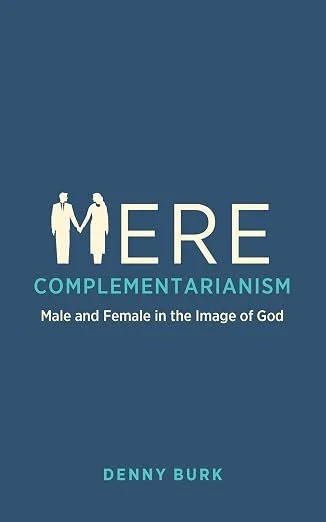
A Review of Denny Burk, Mere Complementarianism: Male and Female in the Image of God (Christian Focus, 2026)
In his latest book, Southern Baptist Theological Seminary professor Denny Burk seeks to promote a Mere Complementarianism. Burk does not want to defend everything associated with the complementarian movement, but only its “essentials” (9–15)—which he defines as the Danvers Statement. The Danvers Statement was published in 1987, with its chief contributors being John Piper and Wayne Grudem. In 1988, the authors of the statement coined the term “complementarian” for their position and formed the Council on Biblical Manhood and Womanhood (18). Burk is now president of the organization they founded.
Burk is very clear that his defense of “mere complementarianism” is a defense of the Danvers Statement. He writes, “The key thing for us to understand is that the term complementarian was coined to refer to the teaching of the Danvers Statement” (21). Burk notes that the “drafters” of the Danvers Statement avoided “controversial matters that they knew might otherwise divide complementarians.” In agreement with this objective, Burk says, “my aim in the rest of this book is to explain and commend mere complementarianism—that is, what has been common to all complementarians at all times” (22).
Yet herein lies the problem, as “complementarianism” as defined per the Danvers Statement only affirmed a watered-down version of male rule from Scripture and the Christian tradition, in what may be termed a “narrow complementarianism.” And therefore those carrying out all sorts of deviant practices today can claim the label “complementarian,” giving the façade of holding a conservative theology of men and women. To highlight the problem, the PCA this past June at its General Assembly voted that the Danvers Statement is a “biblically faithful declaration”—all the while a good portion of the denomination has Functional Female Officers (i.e., non-ordained women doing things ordained male officers normally do).
Problems with the Danvers Statement
Let me explain some of the problems with the Danvers Statement. While rightly affirming male “headship” and the wife’s duty to “submit” to her husband (Affirmation 5), the statement can be easily misused because of omissions. Danvers speaks of the wife’s tendency to replace “willing submission” with “usurpation or servility” (Affirmation 3), saying that “wives should forsake resistance to their husbands’ authority and grow in willing, joyful submission to their husbands’ leadership” (Affirmation 6). This is certainly sound. However, if a “complementarian” softens what the husband’s leadership should look like—to something like the occasional exercise of a “tie-breaking vote”—then he can affirm that the wife should submit in those rare occasions (and only in those rare occasions). Danvers doesn’t really spell out what headship should look like. It seems to have intentionally avoided the word “rule” (as used in 1 Tim. 3:4-5, NKJV). In speaking of “the husband’s loving, humble headship” (Affirmation 4), Danvers uses suitable language, but it is language that is insufficient to counter egalitarianism. Instead, Danvers paints the husband’s headship especially in negative terms: “husbands should forsake harsh or selfish leadership and grow in love and care for their wives” (Affirmation 6).
Additionally, the Danvers Statement is weak on natural law, despite Burk’s appeal to the statement’s language that “distinctions in masculine and feminine roles” reflect the “created order” that “should find an echo in every human heart” (21; Affirmation 2). That is true, of course, but Danvers says nothing about how God’s particular commands for male and female conform to His design of their bodies. Nothing in the statement says that things like women forsaking domesticity or entering combat are contrary to nature (Deut. 22:5).
But most significantly, the Danvers Statement is extremely weak on restricting women in the church. It has one statement of constraint: “some governing and teaching roles within the church are restricted to men” (Affirmation 6). That’s it. Nothing is said of whether women may be ordained as elders. This opens the door to a very narrow complementarianism. If all one has to affirm is that “some” roles in the church are restricted to men, then one could technically hold that “women may serve as pastors and elders, just not senior pastors,” and still affirm Danvers. The same is true for one who holds that “women may occasionally preach under the authority of the elders.” Burk even notes there is a “‘complementarian’ case for women serving as pastors,” which he rightfully opposes (245). This position, advocated by Sam Storms, holds that the term “pastor is not an office in the New Testament but a gift” (245).
Such omissions in the Danvers Statement are a massive problem. The PCA is currently facing a crisis over what has been termed Functional Female Officers, as women in some churches are being “commissioned” (rather than ordained) as “shepherdesses” or deaconesses, and some women are leading portions of the public worship service (such as leading prayer and publicly reading Scripture). Danvers does not forbid these practices. Yet Burk rightly criticizes Kathy Keller’s position that “a woman may do anything an un-ordained man may do.” He says that “when Keller’s logic is brought to bear in such churches, it allows for women to preach and teach the entire congregation” (5). But here we must ask, on what basis couldn’t Kathy Keller sign on to the Danvers Statement?
Danvers and Narrow Complementarianism
Burk is aware of two different camps within the complementarian movement: broad vs. narrow complementarianism (or hard vs. soft, thick vs. thin). Burk rightly holds to a broader complementarian position. He acknowledges that narrow complementarians only teach a sort of “tie-breaking vote” where the husband’s “servant leadership” is “short on authority and leadership” (4). In discussing narrow complementarianism in the church, he lists as examples the position of Kathy Keller, as well as the practice of severing the function of elder from his office (6). Burk notes that “Ideological [narrow] complementarians treat the Bible’s commands as arbitrary rules overlaying an egalitarian nature” (219).
So Burk wants to defend a “mere” Danvers theology, but he does not seem to recognize that the statement’s weakness is a contributing factor to the complementarian movement’s fracturing into broad and narrow camps. In other words, Burk wants to recover a broader complementarianism, while at the same time he defends the “mere” (narrow) complementarianism of the Danvers Statement. Burk even unwittingly acknowledges the failings of the Danvers Statement when he says:
Complementarians who agree with one another in their affirmation of the Danvers Statement may not always agree about how to apply that teaching in the life of the family, the local church, and beyond. One reason for such disagreement is the fact that the Danvers Statement is heavy on biblical/theological principle but light on specific application. For example, Danvers says that ‘some governing and teaching roles within the church are restricted to men.’ This is a broad statement of principle that doesn’t specify how this might flesh out in a given local church. (218)
The claim that Danvers is “light on specific application” is quite the understatement. Burk goes on to ask pertinent questions about the Danvers Statement’s claim that “some governing and teaching roles within the church are restricted to men”:
What roles is it referring to? What about ordination? Can both men and women be ordained? … Can both men and women hold office? Can both men and women preach? Can women teach a Sunday school class at which men are present? Can women be named as ‘pastors’ in churches that view pastoring as a gift and not an office? All of these are practical questions that aren’t addressed in so many words by Danvers. (218, italics mine)
This is quite the admission from Burk. He’s acknowledging that the Danvers Statement can’t even limit the office of pastor or elder to men! If this is “complementarianism,” then I fail to see the benefit of the label or movement. Now, to his credit, Burk goes on to argue the correct answers to many of his questions. But he is clear that doing so takes him beyond the Danvers Statement—“Because of differences in application among complementarians, I will not call my applications ‘mere complementarianism.’ Nevertheless, I will call it an attempt to apply ‘mere complementarianism’ within my own ecclesiological context” (219).
So in order to get to a broader position, Burk has to “apply” principles from the Danvers Statement. Of course, not everyone will agree that his positions are a proper application of those principles. And now we’re left with the question of what good the Danvers Statement actually does. Confessional statements are supposed to provide clarity, not leave important questions unaddressed. So the problem isn’t merely that Danvers fails to enumerate every application—it’s that if “complementarianism” means adherence to Danvers, then the label itself cannot distinguish Burk’s position from positions he regards as seriously defective.
Burk on 1 Corinthians 14:34-35
It also cannot be ignored that Burk contributes to the problem of women leading in public worship by abandoning the traditional view of 1 Corinthians 14:34-35. Like many complementarians of the past three decades, Burk takes the novel view that Paul in this passage was only prohibiting women from evaluating prophecy (210, 234). Contrary to the overwhelming consensus of Christian interpretation prior to the twentieth century (and with zero interaction with my extensive work on this subject), Burk takes 1 Corinthians 11:5 to be permission for women to speak publicly in the worship service. That passage says, “But every woman who has her head uncovered while praying or prophesying disgraces her head” (1 Cor. 11:5). Burk assumes that “the women are praying and prophesying in the assembly,” even though older commentators like Calvin and Warfield argued against this assumption (199). Worse, Burk’s only critique of the traditional reading of 1 Corinthians 14:34-35 (that women may not speak publicly in the worship assembly) is that this “would create a hopeless contradiction with what Paul says in 1 Corinthians 11:5, which indicates that women were ‘praying and prophesying’ in the church” (207–208). Burk does not interact with the proposed solutions found in commentaries by the likes of Calvin and Charles Hodge.
With no interaction with the older writers or academic literature against his position, Burk goes so far as to rebuke those who hold a more conservative position—“we go beyond the example of Scripture if we foreclose what Paul clearly allows—women praying and sharing God’s revelation during worship services.” He adds, “it would be totally in keeping with Paul’s instructions for women to be reading Scripture and praying during the gathered assembly of God’s people” (212). Interestingly, Burk’s church doesn’t let women lead anything in their Sunday worship services, but he says, “we have women praying and reading Scripture in our weekly prayer meetings and in special services (at Easter and Christmas)” (213). This reveals that Burk’s complementarian theology is not as “broad” or historically rooted as he might let on. Burk claims that “the theological position” of complementarianism is “quite ancient” (19), but the practice of women reading Scripture and leading prayer during public worship is anything but. While he may not realize it, Burk’s commentary here has opened the door to the very narrow complementarian position he claims to oppose.
Complementarianism or Patriarchy?
Regarding the debate over the term “patriarchy,” Burk acknowledges such nomenclature is “a matter of prudence and wisdom, not a matter of Scriptural necessity” (283). I am in full agreement with him here, though I should emphasize that this also applies to the term “complementarianism”—a clunky term with more letters than “supralapsarianism.” Burk thinks the term “patriarchy” carries too much baggage, and I understand the concern. He’s aware this also applies to the term “complementarianism,” but he says in response: “Soft-complementarian abuse of the label complementarian is no grounds for abandoning the term complementarian altogether” (285). However, that raises the question—are soft complementarians really abusing the term “complementarian”? Or is the problem simply that the Danvers Statement is fatally flawed?
Burk says one of the problems with “patriarchy” is the term has “no creedal definition” (285). That is true. And even though I’ve used the term for my position, I’m not particularly tied to it. I often say that I’m simply advocating the “traditional Christian view of men and women.” However, “patriarchy” is widely understood today to refer to a set of views on the right of the debates over gender roles. Advocates claim that their position represents the overwhelming Christian tradition prior to the twentieth century (in which theological liberalism arose). So we don’t really need a “creed” on the matter. It would be like saying we need a “creed” to oppose sexual immorality. I mean we have creeds that touch on it (like the Westminster Larger Catechism). But the Bible’s teaching is quite clear on the matter, and there was widespread agreement until recently. My book, Honor Thy Fathers, shows that the older Reformed theologians were widely agreed on male rule in the home, church, and civil government.
It is clear from Burk’s language that writings by modern proponents of patriarchy have influenced complementarianism, moving things in a better and more biblical direction. This is good news. For example, Burk says “male and female differences are rooted in God’s good creation design” (nature) and thus he concludes that “there are implications that reach beyond the church and the home” (7). He says, “A man does not leave his masculine nature behind when he leaves the home and the church and enters the wider world, and neither does a woman. Also, the Scriptural commands concerning men and women are fitted to nature” (219–220).
I have criticized complementarians for avoiding the term “hierarchy,” but Burk recovers it by speaking of “the obvious hierarchical overtones of biblical complementarity” (172). He also speaks of domestic work as a duty, referring to wives having “a God-ordained calling to care for the children and for the home” (190). Burk says, “The wife has the particular assignment to care for and manage the home. Whatever else she does, she cannot shirk her primary duty to care for the home and those who live in it” (161).
While Burk does not interact with my work in the main text of the book, in an appendix on Biblical Patriarchy he quotes my book Masculine Christianity as an example of patriarchy advocating “a consistent biblical view of men and women where men rule in the home, church, and society.” Unfortunately, Burk mischaracterizes my position by immediately commenting, “While I would agree that male and female difference has implications wherever men and women can be found, that does not mean that all men have God-given authority to rule all women” (286, italics mine). That’s not a fair inference from that statement, nor is it supported by anything else I’ve written. In fact, I explicitly rejected such a mischaracterization on page 67 of Masculine Christianity: “This is not to say that all men have authority over all women.”
Overall, Burk does promote a broader complementarianism in Mere Complementarianism, and I commend him for that. He and I seem to agree on much regarding these matters. It is good to see that he thinks women should not teach in seminary (234–237), and he limits the office of deacon to men (237–241). However, Burk also wants to defend the Danvers Statement, which, as I’ve argued, allows for a narrow complementarianism. That puts him in a quandary. For if “mere complementarianism” is the Danvers Statement, then Burk is defending narrow complementarianism even though he wants a broader position. My concern is that Burk is missing the problem caused by the Danvers Statement and the complementarian movement. And rather than correcting course, he is doubling down on Danvers. Yet he is not consistent in doing so, and he even realizes he can’t be. For he has to move beyond Danvers to defend his broader complementarian views (218–219).
So Burk is correct that the terminology we use—whether “complementarianism” or “patriarchy” or some other term—is “a prudential matter” (288). But that’s exactly why I think we should forego the term “complementarianism,” especially if it’s tied to the Danvers Statement. Burk says he has “yet to encounter any compelling reason to replace” his preferred term “with ‘biblical patriarchy,’” but I think his linking of “complementarianism” to the Danvers Statement provides just that (288).
Moving beyond Danvers is okay. In fact, it’s necessary. Younger Christians don’t care about the Danvers Statement, and as I’ve shown, it won’t help us in our current battles. Maybe at some point we will draft a better theological statement on the differences and duties of men and women. But even now, we have our tradition’s interpretation and application of Scripture on these matters. We can read men like John Calvin and Westminster divine William Gouge. While Danvers has not prevented female pastors in the SBC or Functional Female Officers in the PCA, the recovery of these older Reformed writings is a powerful tool that is bringing reform in the church. We need not be bound to the term “complementarian.” And that’s especially the case if it’s tied to the Danvers Statement. Instead, let us claim our Christian tradition prior to the rise of feminism.